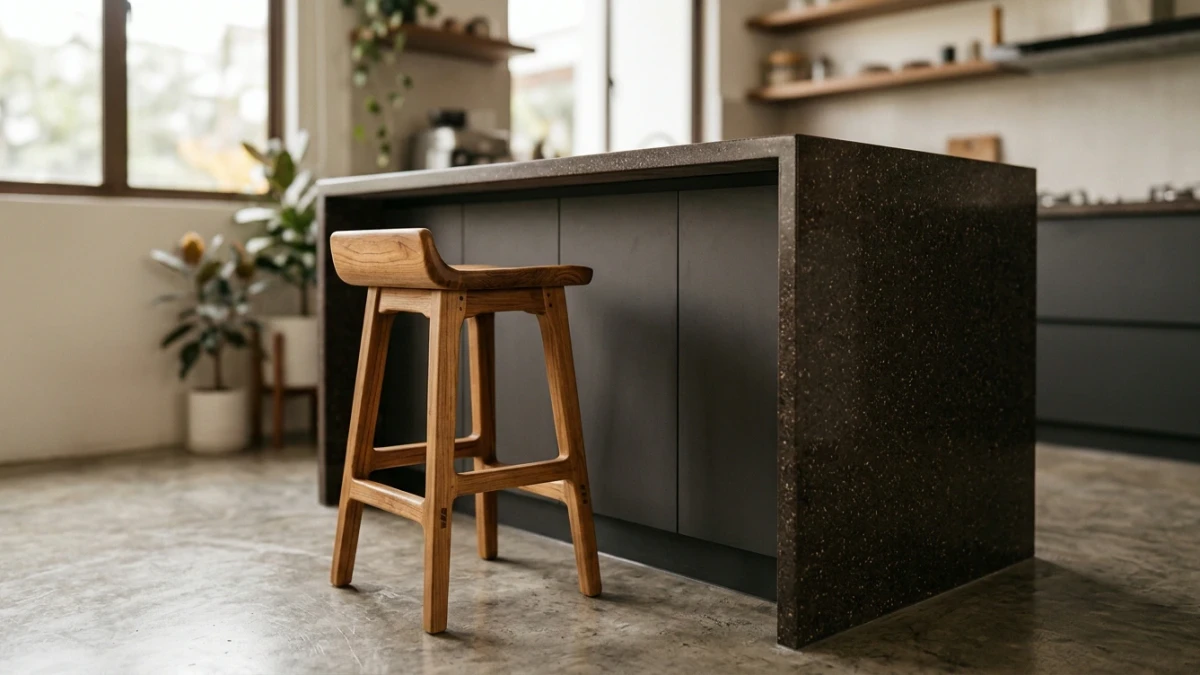
A custom barstool is built around your counter height, your kitchen and the people who sit on it, instead of forcing you to work around a fixed stock size. That difference matters more than most buyers expect, because a stool that sits an inch too high or too low turns an everyday seat into a daily annoyance. This guide walks through how a made-to-order wood barstool is specified, from seat height and backrests to wood species and finish, so you can brief a maker with confidence.
Nicchris designs and builds this kind of seating in-house in Sungai Buloh, Selangor, so much of what follows comes from the practical side of making stools, not just styling them.
Why Custom Barstools Beat Off-the-Shelf
The main reason to go custom is fit. Standard barstools are sold in a handful of fixed seat heights, yet kitchen islands and breakfast bars in the Klang Valley come in many different counter heights, especially in renovated condominiums and landed homes where the island was built to order.
When the stool height is set for your exact counter, you get the clearance that makes sitting comfortable. A good rule is to leave 10 to 12 inches between the seat top and the underside of the counter, which gives knees room to move without knocking the surface. Buy a stock stool and you either accept a near-miss or start hunting for the one size that happens to match.
Fit is not the only gain. Custom work lets you choose the wood, the backrest style, the footrest position and the finish as a set, so the stools belong with the rest of the room. You can also specify seat width and leg splay to suit how many stools need to line up along the island. A near-miss on a stock stool is something you live with every day, whereas a specified one is sized once and forgotten.
Choosing Heights, Backs and Footrests
Three decisions shape how a barstool feels day to day: its seat height, whether it has a back, and where the footrest sits. Get these right and the stool disappears into normal use. Get them wrong and people notice every time they sit down.
Getting the seat height right
Start with your counter, not the stool. Measure from the floor to the underside of the countertop, then subtract 10 to 12 inches for the seat height. In practice, a standard kitchen counter around 36 inches suits a counter-height stool of roughly 24 to 26 inches. A taller bar counter near 40 to 42 inches calls for a bar-height stool of about 29 to 32 inches.
These figures are furniture convention rather than a regulated standard, so treat them as a starting point and adjust for the people who will actually use the seats. Taller users often prefer the upper end of each range.
Backs, no backs and footrests
Backrest choice comes down to how long people sit. Backless stools slide fully under the counter, keep sightlines open and let you squeeze in an extra seat, which helps in compact kitchens. Low or full backs give support for longer sitting, so they suit homes where the island doubles as a casual dining spot.
The footrest earns its keep on taller stools. Because feet cannot reach the floor, a well-placed rail takes the weight and keeps the posture relaxed. On a solid wood stool, that rail also takes real wear, so it needs sturdy joinery rather than a thin cosmetic bar. We go deeper into comfort and proportion in our wooden seating guide for kitchen bar stools.
Solid Wood Species and Finish Options
Wood choice affects durability, appearance and how the stool copes with Malaysia's climate. One useful way to compare species is the Janka hardness scale, which measures how well a wood resists denting and wear. Harder woods tend to shrug off the knocks that barstool legs and footrests take over the years.
White oak sits at around 1,360 lbf on the scale, red oak at 1,290, teak at 1,070 and black walnut at 1,010, with plantation rubberwood lower at roughly 960 (The Flooring Institute, Janka Hardness Comparison, retrieved 2026-11-20). Higher numbers mean better dent resistance, though every one of these woods is used in quality furniture. Hardness is only one factor alongside grain, colour and moisture behaviour.
Climate is where species choice gets practical. Malaysia's average relative humidity runs between 70 and 90 percent, with most areas sitting above 80 percent (Malaysian Meteorological Department, Iklim Malaysia, retrieved 2026-11-20). That constant moisture is why wood needs to be properly dried and sealed before it ever becomes a stool.
How the common species compare
- Teak: natural oils give strong moisture resistance, which makes it forgiving in humid kitchens. Warm golden tone that deepens with age.
- Oak: hard and dependable with a clear, open grain. Takes stains well and seals cleanly for humid conditions.
- Walnut: prized for its rich dark colour and smooth finish. Softer than oak, so it rewards careful handling.
- Rubberwood: sustainable, plantation-grown and budget-friendly. Needs a good moisture-resistant finish to stay stable here.
Finish is the other half of the equation. An oiled finish keeps the wood looking natural and is easy to touch up, while lacquer or polyurethane builds a tougher, wipeable surface that suits a kitchen where spills happen. Whatever the species, a sound sealed finish is what protects the timber against the humidity figures above, and simple regular cleaning keeps it there.
Designing Stools to Match Your Kitchen
Barstools rarely sit alone. They line up against an island, next to cabinetry and often within sight of a dining table, so their proportions and tone need to agree with everything around them. Designing them as part of the room, rather than as an afterthought, is where custom work pays off.
Wood tone is the first thing to coordinate. If your island has a timber top or your dining set uses a particular species, matching or deliberately contrasting the stool wood keeps the room coherent. A maker can match grain direction and finish sheen so the pieces read as a family.
Spacing matters too. Allow roughly 24 to 26 inches from the centre of one stool to the next, so people are not bumping elbows, and keep a small gap between stool edges. In a typical condominium kitchen where island length is limited, that spacing often decides whether you fit two stools or three, which is exactly the kind of detail a made-to-order design can resolve by trimming seat width slightly.
Think about the stool silhouette against the island as well. Slim legs and backless seats keep a small kitchen feeling open, while a stool with a defined back adds presence in a larger, open-plan layout.
The Nicchris Made-To-Order Process
Nicchris designs and manufactures furniture in-house, which means a barstool can be specified to your counter height, wood, finish and backrest rather than chosen from fixed options. Because the design and the workshop sit together in Sungai Buloh, measurements and material choices stay connected through the whole build.
The starting point is your counter. With the counter height and island dimensions, the seat height and footrest position are set to give that 10 to 12 inch clearance. From there you choose the wood species and finish, the backrest style and the seat width, and the stools are built to those figures.
This is the same made-to-order approach Nicchris applies across its wood furniture. Building in-house also means the joinery on load-bearing parts, like footrest rails and leg joints, is made to hold up to daily use rather than to a price point.
If you are weighing up barstools for a new island or replacing a set that never quite fit, the most useful next step is to measure your counter height tonight and note it down. That single number decides almost everything else. From there you are welcome to explore the Nicchris wood seating range or arrange a visit to the Sungai Buloh showroom by appointment to sit on the options and compare wood tones in person.