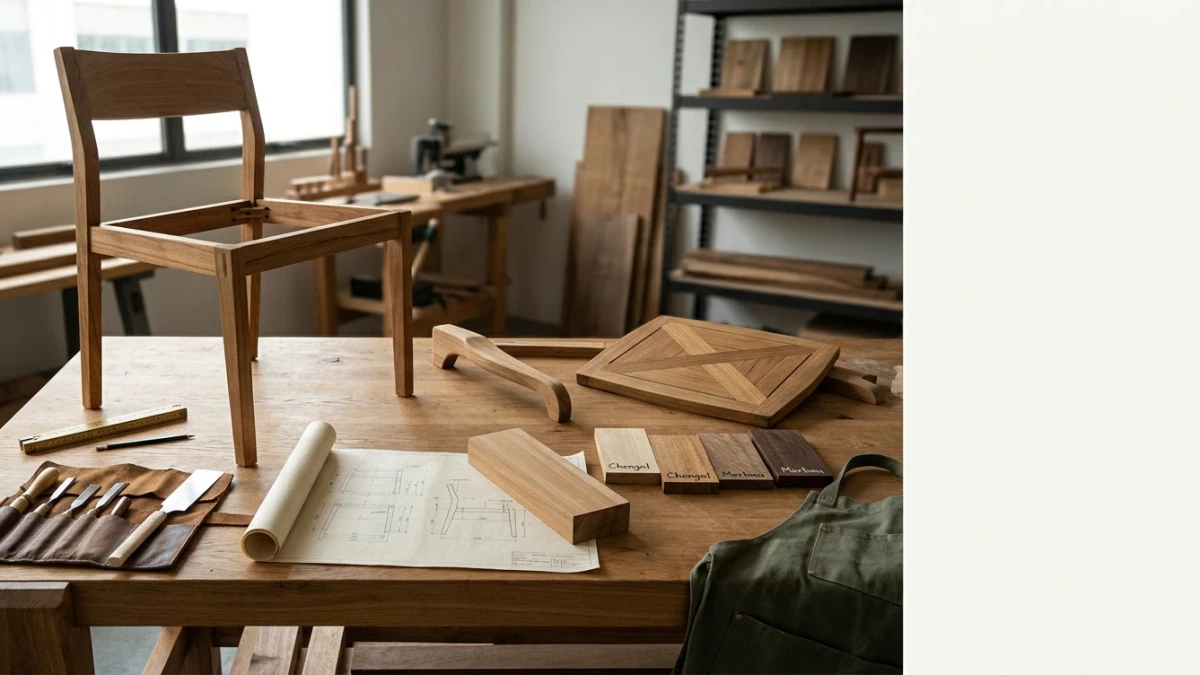
Custom furniture in Malaysia follows a set path: you brief a maker, they draw and quote the piece, you approve the wood and finish, and the workshop builds it to your exact dimensions. The result is furniture sized and finished for your room rather than a compromise pulled off a showroom floor.
This guide walks through that process the way it actually runs in a working Sungai Buloh workshop, so you know what each stage involves, what to decide, and how long the whole thing takes before you commit any money.
Why Choose Bespoke Instead of Off-the-Shelf
Bespoke furniture earns its place when your space, proportions or storage needs fall outside standard sizing. A stock sofa comes in fixed widths and seat depths. A made-to-order one can be built to the exact wall length in your condo, with the seat depth that suits how your family actually sits.
Malaysia has a deep furniture manufacturing base to draw on. The country exported RM12.53 billion of furniture in 2025 (The Edge Malaysia, March 2026), which tells you the skill and supply chain for quality work are already here. Buying custom locally keeps you close to that capability.
The practical reasons to go bespoke tend to be concrete rather than romantic:
- Fit: awkward alcoves, narrow lift lobbies and non-standard ceiling heights in Klang Valley apartments rule out many stock pieces.
- Proportion: a dining table scaled to seat six comfortably in a specific room, not rounded to the nearest catalogue size.
- Material choice: you pick the wood species, the finish sheen and the upholstery, rather than accepting what a range happens to offer.
- Repairability: a piece built with solid joinery can usually be refinished or repaired years later.
Off-the-shelf still wins on speed and price for ordinary needs. If a standard coffee table fits your room and budget, buy it. Bespoke is for when it does not.
How Custom Furniture Is Made, Step by Step
The made-to-order process moves through six stages, each with a point where you check the work before it goes further. Understanding the sequence helps you give useful input at the right moment instead of asking for changes after a piece is already cut.
1. Brief and measurement. You describe the piece, the room and how it will be used. Good makers ask about seating numbers, traffic flow and what sits nearby. Accurate room measurements matter most here, since a few centimetres decide whether a cabinet clears a doorway.
2. Design drawing and quotation. The maker turns the brief into a drawing with dimensions, then prices it. Read this stage carefully. Dimensions, wood species, finish and the lead time should all be written down, not left to memory.
3. Material selection and approval. You confirm the wood, the finish sample and any upholstery. Seeing a physical sample beats a photo, because wood tone and grain vary between boards.
4. Construction. The workshop cuts, joins and assembles the piece. This is the longest stage and where joinery quality is decided.
5. Finishing. Sanding, sealing and the final coat. Finishing affects both how a piece looks and how well it resists Malaysia's humidity.
6. Delivery and installation. The piece is checked, wrapped and delivered. For large items, confirm access routes early so nothing stalls at the lift.
Nicchris handles all six stages in-house in Sungai Buloh, which means the person who draws your piece can speak to the person building it. That continuity is where much of the quality in a well-made piece comes from, because nothing gets lost in a handover between separate suppliers.
Choosing Wood Species and Finishes
Wood species should be chosen for how the piece will be used, not just how it looks, because density, grain and movement differ sharply between timbers. A dining table top takes daily wear and benefits from a harder, stable species. A cabinet panel has an easier life and opens up more options.
Here is how common choices compare for furniture in a Malaysian home:
- Teak: oily, dense and naturally stable, which is why it handles humidity well and ages to a warm tone. A strong pick for surfaces that see heavy use.
- Oak: hard with a clear, open grain. Takes finishes cleanly and suits a lighter, contemporary look.
- Walnut: softer than oak with a rich, dark grain. Prized for show surfaces and feature pieces rather than high-wear tops.
Solid wood is not automatically the right answer everywhere. High-quality veneer over a stable core is widely used in good furniture for large flat panels and cabinet doors, where it resists warping better than a wide solid board and uses timber efficiently. Solid wood earns its place on edges, legs and tops that take knocks and can be sanded back over time.
Finish matters as much as species here. A sealed, matte finish is forgiving and easy to maintain, while a high-gloss surface shows every mark. Whatever you pick, wood responds to the climate: Malaysia's relative humidity runs between 70 and 90 percent (WeatherOnline, climate reference). That moisture makes finish quality and ongoing care genuinely important, which we cover in detail in our guide to caring for wood furniture in Malaysia's climate.
Timelines and What to Expect
A bespoke piece takes time because it is built from raw material to order, not pulled from stock. A dining table or sofa typically runs to several weeks from approved drawing to delivery, with the exact figure driven by complexity, wood species and the finishing work involved. Ask for that lead time in the quotation so it is a commitment, not a guess.
What sits behind the timeline:
- Material sourcing: a specific species or board width may need to be ordered in.
- Construction: proper joinery and drying between steps cannot be rushed without weakening the piece.
- Finishing: multiple coats with curing time between them, especially for surfaces that take wear.
- Your approvals: the clock effectively pauses while you decide on samples, so quick sign-off keeps things moving.
Plan around real events. If you want a dining table ready for a family gathering, start the conversation well ahead rather than close to the date. The same applies to a renovation: order furniture once your layout is locked, since late dimension changes reset the drawing stage.
Expect a deposit structure, usually a payment to begin and a balance on completion. Keep the written quotation, because it is your reference if a delivered piece differs from what was agreed.
Visiting the Nicchris Workshop in Selangor
Visiting the workshop before you approve materials is the single most useful step a buyer can take, because wood tone, finish sheen and build quality are hard to judge from a screen. Nicchris designs and manufactures in Sungai Buloh, Selangor, so the showroom sits alongside the place the work happens.
A visit lets you handle finish samples, compare wood species side by side and see completed pieces at full scale. Catalogue photos flatten grain and colour; a board in daylight tells the truth. It is also the easiest way to talk through proportions, since standing beside a table reads very differently from a dimension on paper.
If you are weighing bespoke against a ready-made buy, seeing both in person settles it fastest. Arrive with a shortlist of questions about species, finish and lead time, so the visit does real work.
The most reliable way to get a custom piece you are happy with is to start early, check samples in person and get every dimension, material and lead time written into the quotation. If you are in the Klang Valley and thinking about a made-to-order table, sofa or cabinet, book a showroom appointment in Sungai Buloh and bring your room measurements. That one conversation will tell you more than hours of scrolling through photos.