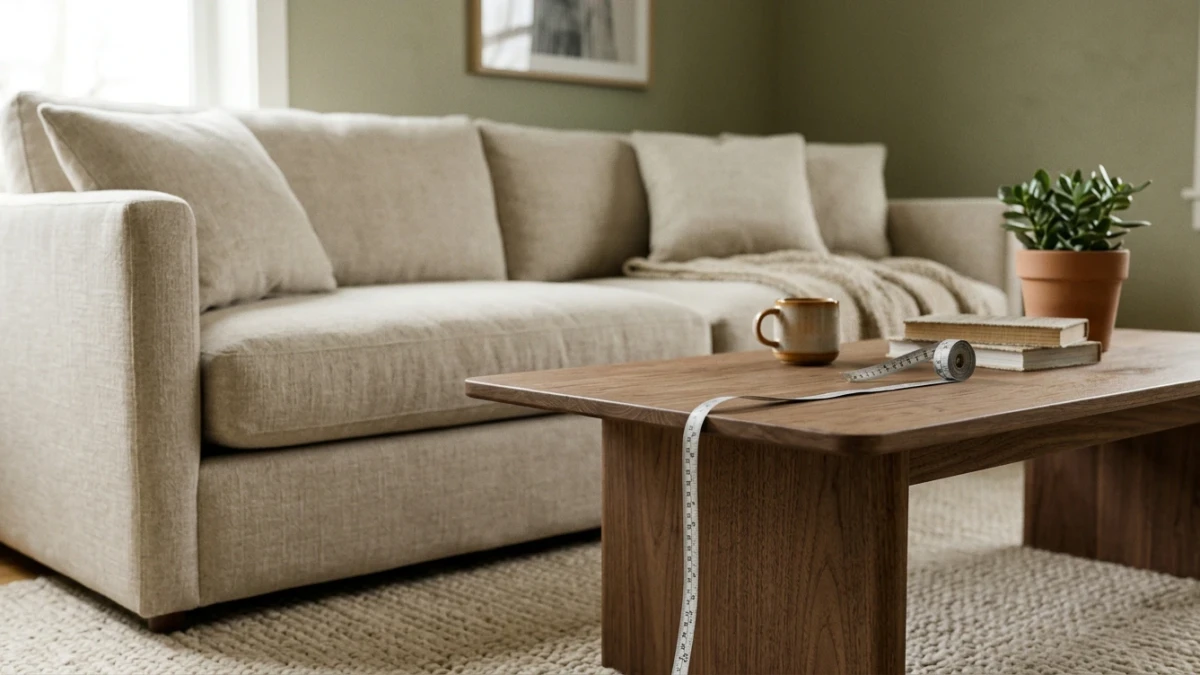
Start with your sofa. A coffee table works best when its top is level with or slightly below your sofa seat, sits close enough to reach without stretching, and runs about two-thirds the length of the sofa. Get those three measurements right and almost any coffee table, modern or classic, will feel at home in your living room. This guide walks through height, shape, material, storage and styling so you can measure your space once and shop with confidence.
A good coffee table does quiet work every day. It holds your drink, your remote, a book and the occasional pair of feet. It also sets the visual center of the room. The pieces below are the ones worth slowing down for before you buy.
How Do You Match Coffee Table Height to Your Sofa?
Match the table to your sofa first, because height is what you feel every time you set down a cup. The comfortable range for most living rooms sits around 40 to 46 cm tall. Aim for a top that lines up with your sofa seat cushion or falls a couple of centimetres below it. That keeps reaching natural and stops the table from blocking the line of your sofa.
Proportion matters as much as height. A table that is too small looks lost in front of a long sofa, and one that is too large crowds the seats. A simple rule helps: choose a table about two-thirds the length of your sofa. For a three-seat sofa near 210 cm, that points to a table around 120 to 140 cm long.
Spacing is the third measurement. Leave roughly 30 to 45 cm between the sofa edge and the table. Close enough to reach a drink, far enough to walk past and stretch your legs. If the room is a thoroughfare, keep a clear path of about 70 cm or more around the table so no one has to squeeze by.
Which Coffee Table Shape Suits Your Layout?
Shape follows the way your room is arranged. Rectangular tables pair naturally with long sofas and rooms where seating faces a wall or a screen. They give you the most usable surface and read as calm and orderly. If your sofa stretches across one side of the room, a rectangle will almost always sit right.
Round and oval tables earn their place in smaller rooms and family homes. With no sharp corners, they ease foot traffic and feel kinder around small children. They also suit L-shaped sofas, where a rectangle can leave an awkward gap. A round table lets people approach the seat from any side without clipping a corner.
Nested tables are the flexible answer for changing needs. You slide them apart when guests arrive and tuck them back when you want the floor to feel open. For compact apartments, where every piece has to pull its weight, a nest of two or three tables often beats a single large slab. For more on furnishing tight city homes, see our guide to modern furniture for KL apartments.
Which Materials Work Best for a Coffee Table?
Pick the material for how your household actually lives, then for looks. Solid wood is the steady all-rounder. It takes daily use, warms a room, and hides small marks within its grain. A wood table pairs easily with fabric sofas and most colour schemes, which is why it remains the default choice for family living rooms.
Marble and metal push the design further. A marble top brings weight and a cool, luxe surface that anchors a space on its own, though it stains if spills sit too long and needs sealing. Metal frames, often in black or brushed finishes, give a lighter, more graphic look and shrug off scratches. Many modern coffee tables now mix the two, pairing a stone or wood top with slim metal legs.
Glass is the material for making a small room breathe. A clear top lets light and the floor show through, so the table almost disappears and the space reads larger. The trade-off is upkeep, since glass shows every fingerprint and dust. In homes with toddlers, tempered glass or a rounded wood edge is the safer call. A designer survey by the furniture marketplace 1stDibs found curved and boldly shaped silhouettes claimed 47 percent of designer votes for 2025, a sign that softer forms are shaping modern tables across every material (1stDibs, 2024).
Should You Choose Storage or an Open Design?
Decide by how tidy your room needs to stay. Storage tables, with drawers, a lower shelf or a lift top, earn their keep in small or busy living rooms. They swallow remotes, chargers, coasters and magazines, so the surface stays clear and the room looks calmer with almost no effort. A lift-top model doubles as a casual desk or a dining spot on the sofa.
Open designs do the opposite job. A single slab, a pair of slim legs or an airy frame keeps sightlines clear and makes the floor feel larger. In a room that already has plenty of storage, an open table lets the sofa and rug do the talking. The look is lighter, and it suits minimalist and mid-century styles well.
Think about who uses the room. A household with children or a shared apartment usually benefits from hidden storage, while a styled sitting room for quieter evenings can go open and sculptural. There is no single right answer, only the one that matches your daily clutter.
How Do You Style a Living Room Around the Table?
Treat the table as the room's anchor and style outward from it. Start with a rug large enough to sit under the front legs of your sofa and reach beyond the table on all sides. That single move ties the sofa, table and seating into one grouping instead of scattered pieces floating on the floor.
On the table itself, work in layers and vary the height. A stack of two or three books, a low tray to corral small things, and one taller element such as a vase or a plant gives the eye a path to follow. Keep roughly two-thirds of the surface clear so the table still works for cups and feet. Odd numbers of objects tend to look more relaxed than pairs.
Let the table echo the rest of the room without matching it exactly. A warm wood top sits well against cooler greys, and a stone or metal piece lifts a room full of soft textiles. For a fuller approach to pulling a scheme together, our styling guide for furniture and home decor covers how to balance a whole living space. At Nicchris, our modern coffee tables are designed to hold these proportions in mind, so the sizing rules above tend to fall into place.
Measure your sofa this week before you shop: its height, its length, and the clear space in front of it. With those three numbers written down, you can walk into any showroom and know in seconds whether a table will fit your living room or fight it.