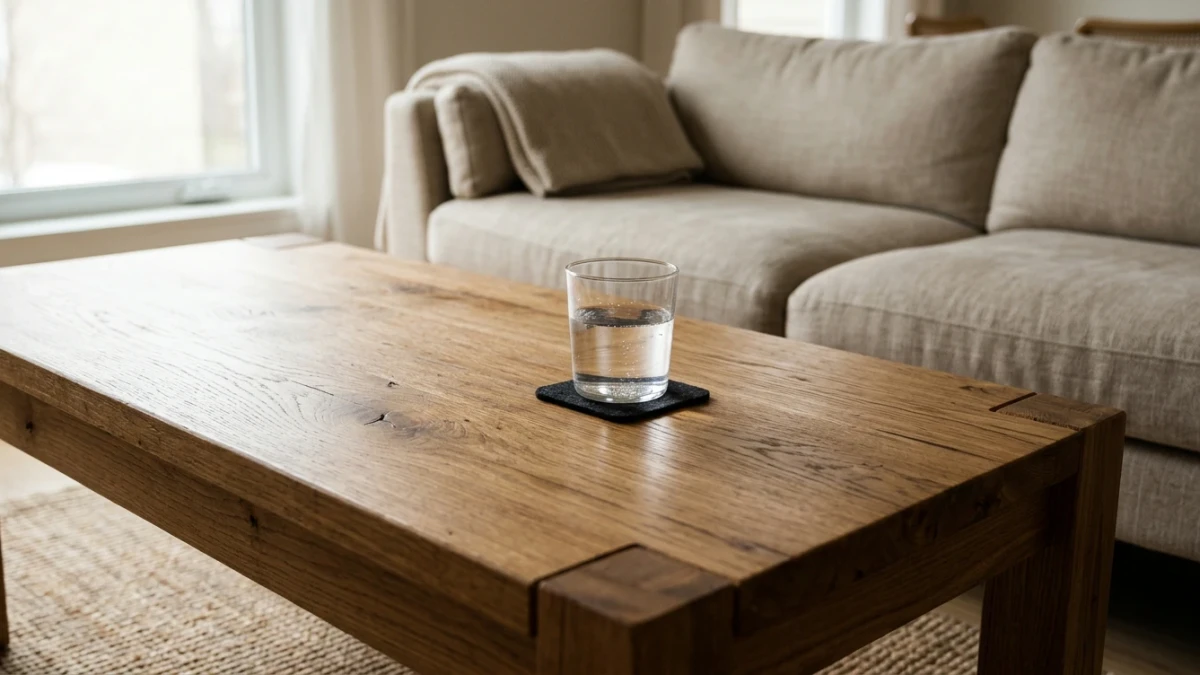
A premium coffee table is worth the money when it is built from solid wood and joined to last, because that is the piece your living room will revolve around for the next twenty years. Spend once on good timber and honest joinery, and you stop replacing wobbly, swollen tables every few years.
For buyers in Sungai Buloh, Selangor and across the Klang Valley, this guide covers what actually separates a premium coffee table from a pricey one: the wood species, the build signals, the right proportions for your sofa, and how to keep a wood top healthy in local humidity.
Why a Premium Coffee Table Anchors a Living Room
The coffee table sits at the visual centre of most living rooms, so it carries more weight in the design than its size suggests. A standard model stands close to sofa seat height, which puts it right in your eyeline the moment you walk in. That central spot is exactly why a cheap, worn top drags the whole room down.
That central position is why the material matters. A solid wood top shows real grain, takes on a patina, and hides the small knocks of daily life in a way a laminate surface cannot. When the table is the first thing guests notice, the warmth of oak, teak or walnut does quiet work that no amount of styling props can fake.
A premium table also sets the tone for everything around it. The right piece pulls the sofa, rug and accent chairs into one considered scheme, while the wrong one leaves even good furniture looking unresolved.
Solid Wood Options: Teak, Oak and Walnut Grain
The three hardwoods most worth considering for a premium coffee table are teak, oak and walnut, and each behaves differently under daily use. On the Janka hardness scale, which measures resistance to denting, teak comes in around 1,155 lbf and black walnut around 1,010 lbf (Woodworking Advisor, 2024).
Teak reads golden-brown and carries natural oils and silica in its grain, which is why it handles moisture and insects so well. That resilience makes it a sensible pick in a humid climate. Oak is the hardest of the three, with an open, pronounced grain and a pale-to-honey tone that suits bright, airy rooms. Walnut sits softer and darker, prized for its deep chocolate colour and swirling figure that turns a plain rectangle into a centrepiece.
Grain is not only about looks. A straight, tight grain tends to stay flatter over time, while dramatic figure needs careful seasoning to behave. A good maker chooses boards for both beauty and stability, then books or matches them so the top reads as one surface rather than a patchwork and warm timber can run through the whole room without the space feeling heavy.
Build Quality Signals That Justify the Price
Price alone tells you nothing. What justifies the cost of a premium coffee table is the construction you can see and feel: solid timber throughout, traditional joinery, and a finish applied by hand. These signals separate a table built to last from one dressed up to look the part.
Here is what to inspect before you buy:
- Joinery. Look for mortise-and-tenon joints or dovetailed drawers rather than staples, dowels or visible screws. Hand-cut joints move with the wood and hold for decades.
- Solid versus veneer. A solid top will show continuous grain that wraps around the edge. A thin veneer over particleboard stops abruptly at a dark seam.
- Finish. Run your hand across the top. A quality oil or lacquer feels smooth and even, with no rough patches, cloudy spots or pooled varnish in the corners.
- Weight and stability. A solid hardwood table has real heft and does not rock when you lean on a corner.
- Underside. Turn it over if you can. Clean, sanded undersides and proper corner bracing show the maker cared about parts you were never meant to see.
This is where a designer maker earns its keep. A brand like Nicchris builds in solid timber and finishes each top by hand, so the construction holds up to the kind of inspection above rather than relying on a thick coat of varnish to hide shortcuts.
Matching Table Proportions to Your Sofa and Space
A premium coffee table only looks premium when it is the right size for the room. Keep the table close to sofa seat height, 16 to 18 inches, and leave 14 to 18 inches (36 to 46 cm) of clearance between the table edge and the sofa. Any less and people kick the table standing up; any more and they lean forward to set down a cup (SizeMarker, 2024).
For length, a common rule is to make the table roughly two-thirds the length of the sofa it serves. A three-seater paired with a tiny table looks lost, while an oversized slab in a compact apartment blocks the walkway. Walkways around the table should stay clear enough to pass comfortably, usually about 30 inches where people move through.
Shape matters too. A rectangular table suits a long sofa, a round or oval top softens a room with lots of hard corners and reads safer in homes with young children. A square table balances an L-shaped or modular sofa. Because so much depends on your exact sofa and floor plan, stock sizes often miss by a few inches. This is a strong case for made-to-order woodwork: a Malaysian maker like Nicchris can build the top to the length and height your room needs, matching the timber to the rest of your pieces rather than forcing a near-fit.
Caring for a Premium Wood Top in Klang Valley Humidity
Solid wood lives well in Malaysia if you respect the climate. The Klang Valley stays warm and muggy for virtually the entire year, and that constant moisture is the main thing a wood top has to contend with. Wood takes on and gives off moisture with the air around it, so stability in the room means stability in the table.
A few habits keep a premium top looking new:
- Control the indoor air. Air conditioning and good ventilation smooth out the swings in humidity that cause timber to swell, shrink and eventually crack.
- Keep it out of direct sun. Afternoon light through a window fades the colour and dries the surface unevenly. Position the table away from the harshest glare.
- Wipe spills fast. Water left to sit leaves rings and can lift the finish. Use coasters for cold drinks that sweat.
- Clean gently. A soft, slightly damp cloth is enough. Skip ammonia, bleach and all-purpose sprays, which strip protective oils.
- Feed the wood. Re-oil or wax the top a few times a year to replace the oils the climate pulls out and to keep the grain rich.
Teak and other oily hardwoods forgive the humid climate more readily than open-grained species, which is part of their appeal here. For a full routine covering every wood piece in your home, read our dedicated guide on how to care for wood furniture in Malaysia's climate.
Making the Investment Count
If you are ready to buy, start by measuring your sofa and the gap you want around the table, then pick the timber that matches both your room's palette and the wear it will take. Bring those numbers to a maker who works in solid wood and can show you the joinery, rather than ordering a stock piece blind. For Klang Valley homes, a made-to-order teak, oak or walnut top sized to your space will outlast a dozen budget tables and look better every year it stays with you.