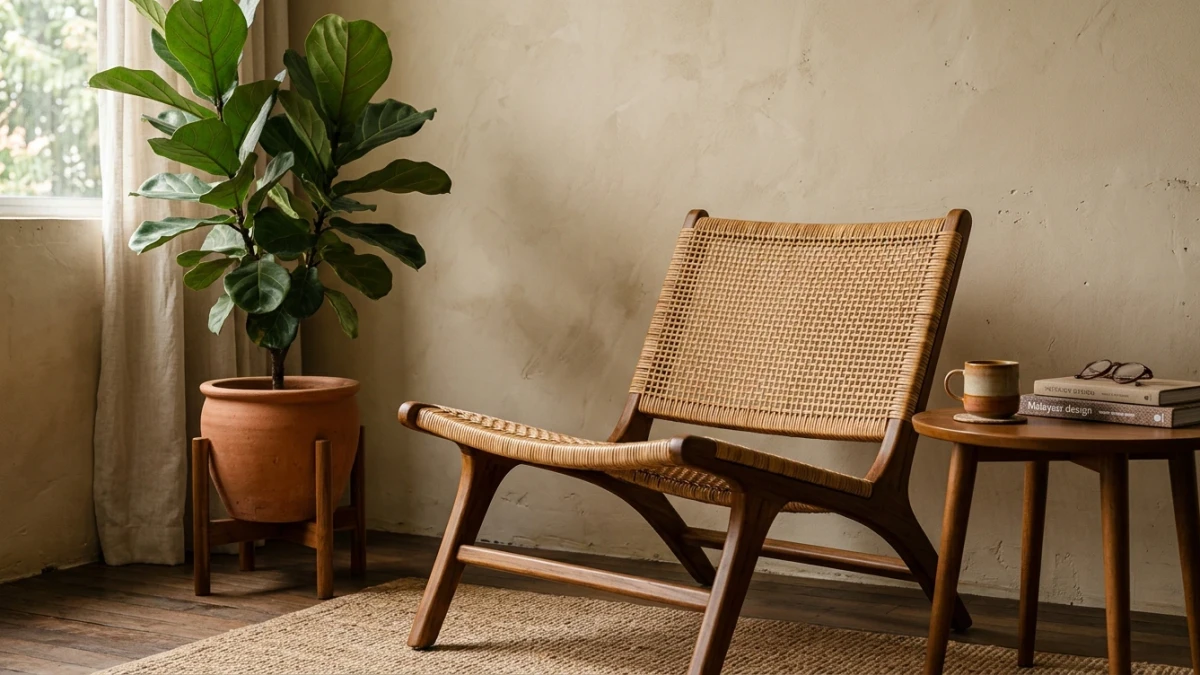
A rattan chair earns its place in a Malaysian home because it adds visible texture and a lighter feel without the bulk of a fully upholstered seat. The weave lets air move through it, it suits our warm climate, and it pairs easily with the solid wood furniture most Klang Valley homes already own. This guide covers what rattan actually is, how to combine it with wood, how to keep it healthy in high humidity, and where it works best around the house.
Rattan is one of the oldest seating materials in this region for good reason. It comes from a climbing palm that grows through the forest canopy across Southeast Asia, including Malaysia, so it has been worked into local furniture for generations. Understanding the material helps you buy a better chair and keep it longer.
What rattan actually is
Rattan is a climbing palm, not a wood and not a grass. According to the Food and Agriculture Organization of the United Nations, there are around 600 species of rattan across 13 genera, with roughly 370 of them in the genus Calamus that supplies most commercial material. Only about 20 percent of all rattan species have any commercial value, so the cane used in furniture is a small, selected group.
The distinction people get wrong most often is rattan versus bamboo. Bamboo is a hollow woody grass, which is why it stays rigid and works for straight, structural lengths. Rattan has a solid core and a natural flex, which is exactly why it can be bent, curved and woven into a chair body that still feels firm when you sit. When you see a chair with a woven back panel and a curved frame, that flexibility is rattan doing the work.
That solid core also gives rattan a good strength-to-weight ratio. A rattan chair can carry an adult comfortably while staying light enough to move with one hand, which matters in apartments and condominiums where furniture gets rearranged more often than in landed homes.
Why rattan suits tropical Selangor interiors
Rattan suits Selangor homes because the open weave breathes in a climate where sitting on solid foam or thick leather can feel warm by mid-afternoon. Air passes through the seat and back, so the chair does not trap heat against you the way a dense cushion does. In a region where indoor temperatures stay high most of the year, that small difference is noticeable.
The visual side matters too. Many Klang Valley interiors lean on tile floors, painted walls and large glazed windows, which can read as flat and hard. A woven chair breaks that up with fine, repeating lines and a warm honey tone, adding interest without the weight of another big timber piece. If you are working toward a calm, pared-back look, rattan slots neatly into the Japandi and Scandinavian directions that have become popular in local homes.
There is also a material-origin argument. Rattan grows natively in the tropical forests of Southeast Asia, so it is one of the few furniture materials genuinely at home in our climate rather than imported into it. It expands and contracts with humidity in a predictable way, and a well-made piece is built with that movement in mind.
Pairing rattan frames with solid wood accents
Rattan looks and performs best when it is grounded by solid wood rather than used alone. Pure rattan furniture can feel lightweight and a little temporary in a room full of heavier pieces, so the stronger approach is a chair that uses wood for the load-bearing frame and rattan for the panels you see and touch. The wood carries the weight and gives the joints their strength, while the weave supplies the texture.
Tone pairing is where this either works or looks accidental. A few combinations that hold up well in Malaysian homes:
- Rattan with teak or oak: warm, mid-toned woods sit close to rattan's natural colour, giving a soft, cohesive look that suits bright, airy rooms.
- Rattan with walnut: a darker wood frame makes the pale weave stand out, which reads as more deliberate and more contemporary.
- Rattan with painted or black-stained wood: high contrast that works in modern interiors, as long as the rest of the room carries that contrast too.
Think about where the wood shows. Legs, arm tops and the top rail are the parts that take knocks and bear weight, so having solid wood there extends the life of the chair. This is the same logic behind choosing a proper solid wood dining chair: the frame is what you are really buying, and the surface finish is what you see. A rattan panel set into a well-joined wood frame gives you both.
At Nicchris, this mix sits comfortably within our made-to-order approach, since the wood species, finish and weave detail can be matched to the other pieces you already have rather than bought off a fixed shelf.
Durability and care tips for humid climates
Humidity is the real test for rattan in Malaysia, and the numbers explain why. The average relative humidity in Kuala Lumpur is around 80 percent, according to timeanddate.com, and Selangor sits in the same climate band. Natural fibres respond to moisture in the air, so a little routine care goes a long way.
The main risks are mould, drying and sagging. Here is how to manage each without much effort:
- Keep airflow around the chair. Mould needs still, damp air. A rattan piece in a ventilated room, away from a wall that gets damp, rarely has a problem. A chair shut inside a closed, unused room is more likely to spot.
- Wipe, do not soak. Dust it with a dry or barely damp cloth. For a deeper clean, use a cloth wrung almost dry, then let the chair air out fully before anyone sits on it. Soaking rattan or leaving it wet is what weakens the weave over time.
- Stay out of direct sun. Long hours of strong sun through a window will fade the colour and dry the cane until it becomes brittle. A spot with bright, indirect light is ideal.
- Re-tension gently if it sags. Some natural give is normal. A lightly misted and then fully dried seat can tighten slightly as the fibres settle. Do not force it.
These habits overlap with general wood furniture care in Malaysia's climate, which is convenient if your rattan chair has a solid wood frame. One cleaning routine covers the whole piece.
One honest limitation: natural rattan is an indoor or covered-patio material. Full outdoor exposure to sun and rain will shorten its life quickly. For open balconies and gardens, synthetic rattan or a weather-suited timber such as teak is the better call, and natural rattan is best kept for interior and sheltered spots.
Styling rattan chairs in living and reading corners
A rattan chair does its best work as an accent seat in a reading corner or a relaxed lounge spot rather than as primary dining or heavy daily seating. Placed by a window with a small side table and a lamp, it becomes an inviting spot to sit with a book or a coffee, and the open weave keeps that corner feeling light instead of crowded.
A few practical placement notes:
- Give it a soft partner. A loose seat cushion or a lumbar pillow makes a rattan chair more comfortable for longer sits and adds a point of colour or fabric texture against the weave.
- Let it stand slightly apart. Rattan reads best with a little breathing room, so it does not have to be pushed tight against a sofa. A reading corner, a bedroom nook or the end of an open-plan living area all suit it.
- Use it to lighten a heavy room. If your living room already has a large timber or upholstered sofa, a rattan chair balances the weight and stops the space feeling blocky. This is the same role a good accent chair plays, with more natural texture.
In a bedroom, a single rattan chair in a corner gives you a spot to sit and a place to drape clothes without adding visual bulk. In a living room, a pair either side of a console or window creates a calm, symmetrical reading zone.
Where to see rattan pieces near Sungai Buloh
Rattan is a material you really want to sit in before deciding, because weave density, frame stiffness and seat depth vary a lot between pieces and photographs flatten all of that. Pressing on the weave, checking how the frame joins and feeling the seat depth tells you more in a minute than any product listing. That hands-on check is worth making before you commit to a chair you plan to keep for years.
For readers in the Klang Valley, Nicchris designs and makes furniture in-house in Sungai Buloh, Selangor, including woven seating built on solid wood frames. Because our pieces are made to order, the wood species, finish and overall proportion can be matched to the rest of your room rather than chosen from a fixed set. If you want to understand how that process works before visiting, our guide on custom-made furniture walks through it.
The practical next step is simple: shortlist one or two rattan styles you like, then sit in them in person and check the frame before you buy. If you are in the area, you are welcome to see our pieces at the Nicchris showroom in Sungai Buloh by appointment, where you can test the seating and talk through wood pairings for your own home.