Furniture craftsmanship is the practical skill of building furniture that is structurally sound, comfortable to use and finished with care. It shows up in three places you can actually inspect: the joints that hold a piece together, the wood chosen for each part, and the surfaces worked by hand. A well-crafted table or chair earns its keep over years of daily use, while a poorly made one loosens, wobbles and starts to look tired.
This guide walks through what furniture craftsmanship really means from a maker's point of view. We will look at the joinery that signals quality, how wood selection affects how long a piece lasts, why hand-finishing matters, and how these decisions come together in made-to-order work here in Sungai Buloh.
Defining Craftsmanship in Furniture Making
Craftsmanship is the sum of decisions a maker gets right before anyone sees the finished piece. It covers how parts are joined, how the wood is cut and seasoned, how proportions are judged, and how surfaces are smoothed and sealed. None of this is decoration. Each choice affects whether a dining table stays flat for a decade or starts to twist within a year.
A useful way to think about it: mass production optimises for speed and consistency, while craftsmanship optimises for how a piece performs and feels over its whole life. Both have their place. The difference is that a crafted piece is built to be repaired, adjusted and lived with, not replaced at the first sign of wear.
You can read craftsmanship in small details. Drawers that glide and close flush. Chair legs that meet the floor without rocking. Grain that runs sensibly across a panel instead of fighting it. These are not luxuries. They are the direct result of a maker understanding how wood behaves and respecting that behaviour at every step.
Which Joinery Techniques Signal Quality?
Joinery is the clearest signal of furniture craftsmanship, because it determines how a piece holds together under daily stress. The strongest traditional joints interlock pieces of wood so they resist pulling apart on their own, with glue as reinforcement rather than the only thing doing the work. According to Encyclopaedia Britannica, the main carpentry joint designs were worked out long ago and have changed little since, which tells you how well these methods have stood the test of use (Encyclopaedia Britannica, "Joint (carpentry)").
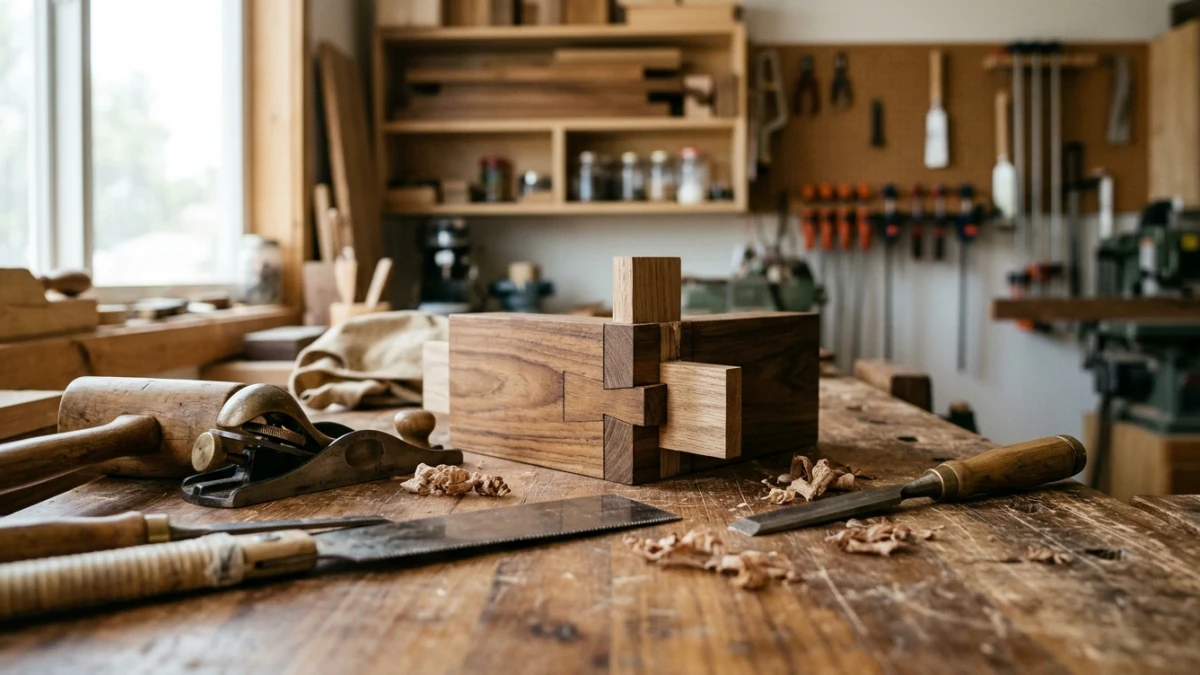
Two joints matter most in quality furniture. The mortise-and-tenon joins a rail to a leg by fitting a tongue of wood into a matching slot, and it carries the heavy structural load in tables, chairs and frames. The dovetail, with its fan-shaped interlocking pins, is the mark of a well-made drawer because it resists being pulled apart from the front. Laboratory comparisons of these joints show each has its strength: dovetails tend to resist pull-out forces well, while mortise-and-tenon joints handle impact and racking loads.
What should you avoid? Furniture held together mainly with staples, bare screws or a few dowels and a lot of glue. Those methods are fast and cheap, but they loosen as the wood moves with changes in humidity. A maker who takes the time to cut proper joints is telling you the piece is meant to last.
How Wood Selection Shapes Durability
Wood selection sets the ceiling for how durable a piece can be, because different timbers vary widely in hardness, stability and moisture resistance. Among furniture woods, white oak sits toward the harder end, while teak and walnut are softer but bring other strengths, based on the standard Janka hardness ordering that measures a wood's resistance to denting (Janka hardness test, Wikipedia). Hardness is not the whole story, but it is a fair guide to how a surface will cope with knocks and daily wear.
Each timber earns its place for different reasons:
- Oak is hard and strong, with an open grain that reads clearly. It suits dining tables and chairs that take constant use.
- Teak carries natural oils that resist moisture and insects, which is why it has long been trusted in humid and outdoor settings.
- Walnut is softer and prized for its deep colour and workable grain, well suited to pieces where appearance leads.
Teak's natural oils deserve a note for anyone furnishing a home in the Klang Valley. Our climate is warm and humid for most of the year, and that moisture makes wood swell and shrink. A timber that handles moisture well, and construction that allows wood to move, together decide whether a piece stays sound. This is also why proper seasoning of the wood before it is cut matters as much as the species itself.
On the question of solid wood against veneer, neither is automatically better. Solid wood can be sanded back and refinished, and it ages with character. A good veneer, meaning a thin layer of real wood bonded to a stable core, resists warping across large panels and uses attractive grain economically. The deciding factors are the quality of the core, the bond and the finish, not the label on the tag.
The Role of Hand-Finishing and Detail
Hand-finishing is where a maker takes control of how a piece feels and how it will age. Sanding through progressively finer grits, easing sharp edges by hand, and applying oil or lacquer in thin, even coats are slow steps that a machine line usually rushes or skips. The payoff is a surface that is smooth to the touch, consistent across the grain and sealed well enough to resist spills and daily handling.
Detail work is easy to overlook until you live with it. Edges that are softened sit kindly against your arms at a dining table. A finish that soaks evenly into the grain avoids the blotchy look that cheaper production leaves behind. Joints that are cut cleanly need less filler, so the wood reads as wood rather than as something patched.
Finishing also protects the investment. In a humid climate, a well-applied finish slows the movement of moisture in and out of the wood, which reduces cracking and warping over time. Good finishing does not remove the need for care, though. Keeping wood furniture out of direct sun and wiping spills promptly still matters, and a simple routine goes a long way in our climate.
How Nicchris Applies Craft to Each Piece
At Nicchris, craftsmanship starts at the design stage and runs through to the final coat of finish. Because we design and make our furniture in-house in Sungai Buloh, the person deciding on proportions is working alongside the people cutting the joints and applying the finish. That closeness is what lets us build a piece around how it will actually be used, rather than around what is quickest to produce.
Made-to-order work is where this matters most. When a customer adjusts a table's dimensions to fit a condominium dining area, or chooses a particular wood tone to sit with an existing floor, those choices feed straight into how the piece is built. We select timber for the job, cut joinery suited to the load, and finish each surface by hand so it holds up in our climate. If you want to understand how a bespoke piece moves from an idea to a finished object, our article on custom-made furniture walks through the process step by step.
The result we aim for is furniture that feels considered and holds together for years. Craft is not about making things ornate. It is about making them right.
If you are weighing up a new dining table, sofa or cabinet and want to see how sound joinery and hand-finishing feel in person, you are welcome to visit our Sungai Buloh showroom by appointment. Bring your room measurements and any material samples, and we can talk through what will work for your space and how it will be built.