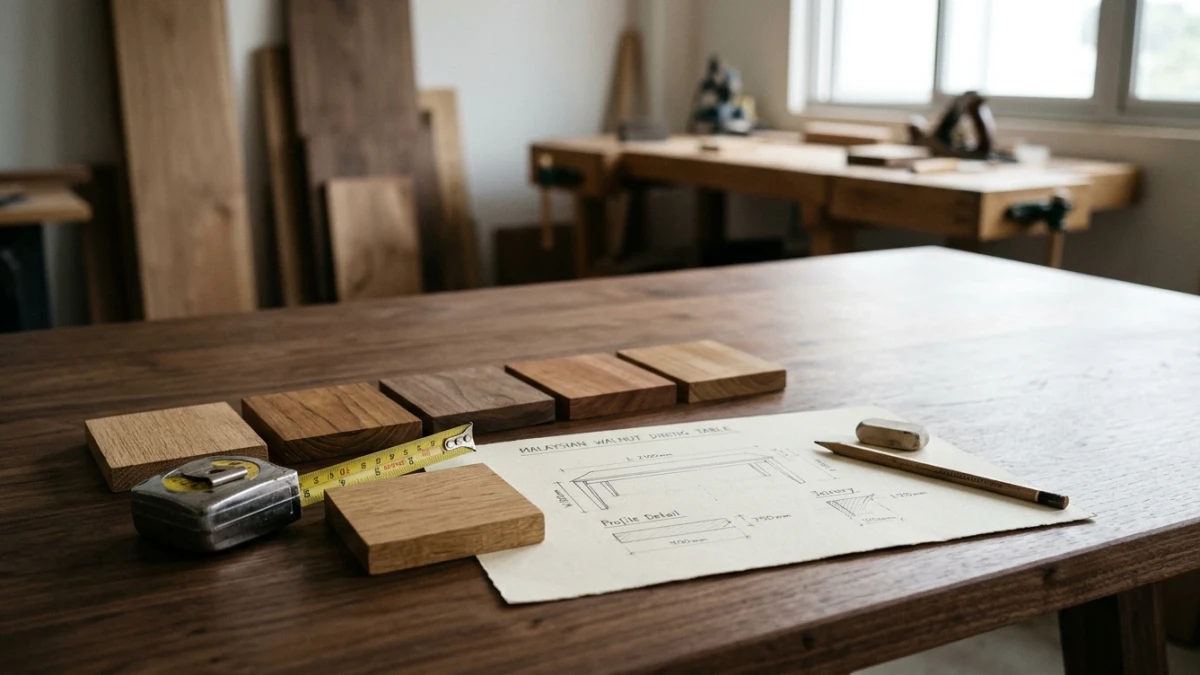
A bespoke dining table is built to the exact size, shape and wood you choose, rather than pulled off a showroom floor to roughly suit your room. For anyone furnishing a home around Sungai Buloh, Selangor or the wider Klang Valley, that difference decides whether people can actually pull out a chair without hitting the wall. This guide walks through how a made-to-order dining table is sized, which woods and finishes suit local homes, and how the design-to-delivery process works from first sketch to the piece arriving at your door.
Why a bespoke dining table fits better
Most dining rooms in the Klang Valley are not standard rectangles. Condo layouts, open-plan kitchens and older terrace homes all have their own awkward dimensions, and a mass-produced table is designed for an average room that may not be yours. A bespoke table starts from your measurements, so the length, width and height suit the space you actually have.
That matters more than it sounds. Dining comfort comes down to clearance: enough room per person at the table, and enough space behind the chairs to sit down and walk past. When a table is a touch too long, the end seats end up jammed against a wall. When it is too wide, the walkway disappears. A made-to-order piece is dimensioned around those constraints from the start.
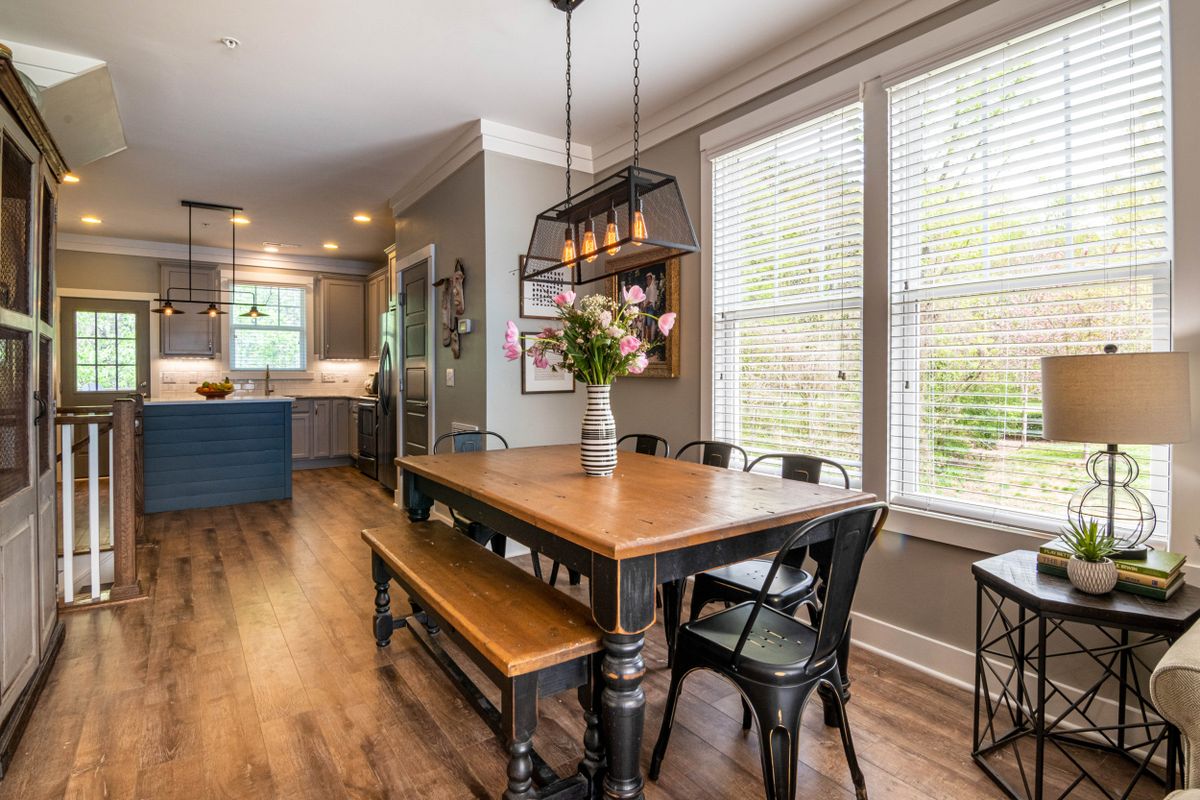
There is also the question of how the table is built. With a custom piece you can specify the thickness of the top, the leg style, the joinery and the finish, which affects both how it looks and how long it lasts. A well-made table shows its quality in these details, not in the showroom lighting.
Choosing size, shape and seating needs
Start with how many people you seat on a normal day, then how many you want to seat when guests come over. A table sized only for your current household tends to feel cramped the moment you host, while one sized purely for entertaining dominates the room the other 360 days of the year. The right length usually sits between those two figures.
Shape follows the room. A rectangular table suits long, narrow dining areas and open-plan layouts, and it scales up easily for larger gatherings. A round table works well in smaller or square rooms because it has no sharp corners to navigate and everyone can see each other, though it gets large quickly as you add seats. For a square room, a square or round table often uses the floor more efficiently than a long rectangle.
Height is worth confirming rather than assuming. Standard dining height suits most dining chairs, but if you are matching an existing set, or you want a slightly lower, more relaxed feel, a bespoke maker can adjust it. The same logic applies to seating: if you are ordering chairs alongside the table, make sure the seat height and table height are planned together so there is comfortable thigh room.
A few practical pointers when planning the size:
- Leave generous room behind each chair so people can get in and out without shuffling sideways.
- Allow comfortable elbow room per diner rather than packing seats in to hit a number.
- Measure doorways and lift dimensions before settling on a length, especially in high-rise Klang Valley condos.
Selecting wood species and finishes
Wood choice shapes how your table looks, how it ages and how much upkeep it needs. A useful objective reference is the Janka hardness scale, which measures how much force a timber resists before denting. Among common dining woods, white oak rates 1,360 lbf and red oak 1,290 lbf, while teak comes in at 1,070 lbf and black walnut at 1,010 lbf (ToolsToday Janka Hardness Chart).
Treat those numbers as a guide to durability rather than a ranking of quality. Harder woods like oak resist surface dents well, which suits a family table that takes daily wear. Walnut is softer on the scale but prized for its deep, dark grain, and it holds up fine indoors with sensible care. Teak sits lower for hardness but earns its place in Malaysian homes for a different reason: its natural oils make it resistant to moisture and movement, which is valuable in a humid climate. The best species for you depends on the look you want and how the table will be used day to day.
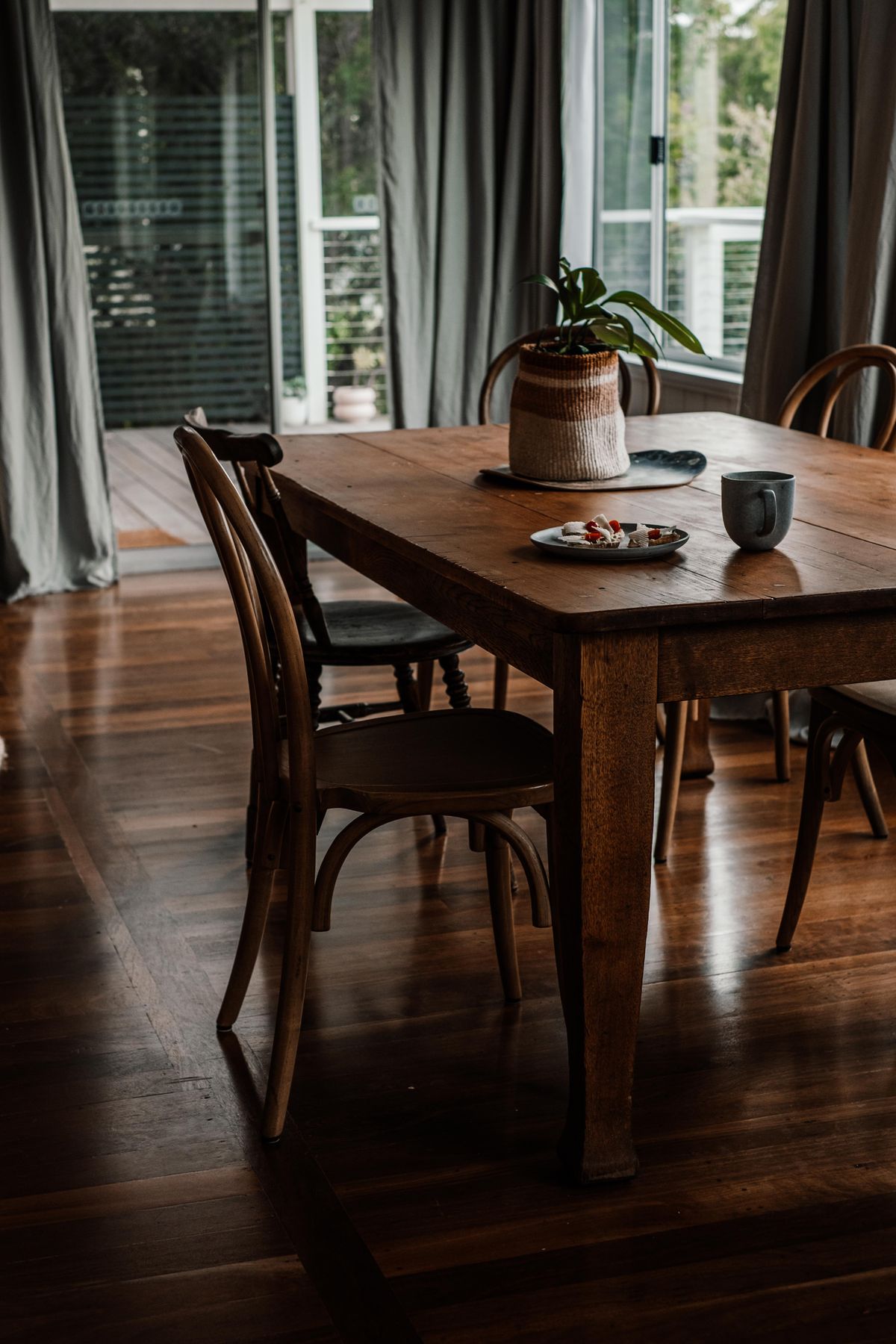
Finish is the other half of the decision. An oil finish sinks into the grain and gives a natural, matte surface that is easy to touch up but needs occasional re-oiling. A lacquer or hardwax finish builds a tougher protective layer that handles spills and heat better, at the cost of being harder to spot-repair. Neither is the "correct" choice. It depends on how you use the table and how much maintenance you are happy to do.
One more point worth clearing up: solid wood is not automatically superior to veneer. A high-quality natural veneer over a stable core can resist warping better than a wide solid slab, and it allows grain patterns that would be wasteful to cut from solid stock. Solid timber, meanwhile, can be sanded back and refinished repeatedly over its life. We lay out the real trade-offs in our piece on solid wood versus veneer furniture.
The design-to-delivery process explained
A made-to-order table moves through clear stages, and knowing them helps you plan. The process usually runs from an initial brief, through drawings and material selection, into the build and finishing, and finally delivery. At NICCHRIS, that work happens in-house at our Sungai Buloh workshop, which keeps design and manufacturing under one roof. Because we design and make our own pieces, we can talk through the trade-offs at each stage rather than handing you a fixed catalogue.
It typically looks like this:
- Brief and measurements. You share your room dimensions, seating needs, preferred style and any existing pieces the table should sit alongside.
- Design and drawings. The maker proposes dimensions, a shape, a leg or base design and a wood species, then refines it with you.
- Material selection. You confirm the timber and finish, often by looking at samples so the colour and grain match your expectations.
- Build and finishing. The table is cut, joined, sanded and finished. This is the longest stage and where seasoning and joinery quality show.
- Delivery and placement. The finished table is delivered and set in position, with the awkward access points you flagged earlier already accounted for.
Because the design is agreed before any wood is cut, there are fewer surprises than buying off the floor. You see the plan, approve the material and know roughly when it will arrive. For a fuller walkthrough of how a custom order is handled locally, see how custom furniture works in Sungai Buloh.
Serving customers across the Klang Valley
Being based in Sungai Buloh puts NICCHRIS within easy reach of homes across Selangor and Kuala Lumpur, which makes the made-to-order process more practical than ordering from far away. Measurements, material samples and delivery all get simpler when the workshop and the customer are in the same region.
Local proximity also helps with the parts of a bespoke order that benefit from a conversation. Matching a table to an existing floor tone, confirming a finish against your lighting, or planning access into a high-floor condo are all easier when you can visit a showroom or have the piece delivered within the Klang Valley.
A good next step is to measure your dining area and note how many people you seat on a normal day versus when you host. With those two figures in hand, you can have a productive first conversation about size and wood. If you would like to see and feel the woods and finishes before deciding, arrange to visit the NICCHRIS showroom in Sungai Buloh by appointment to start shaping your table.