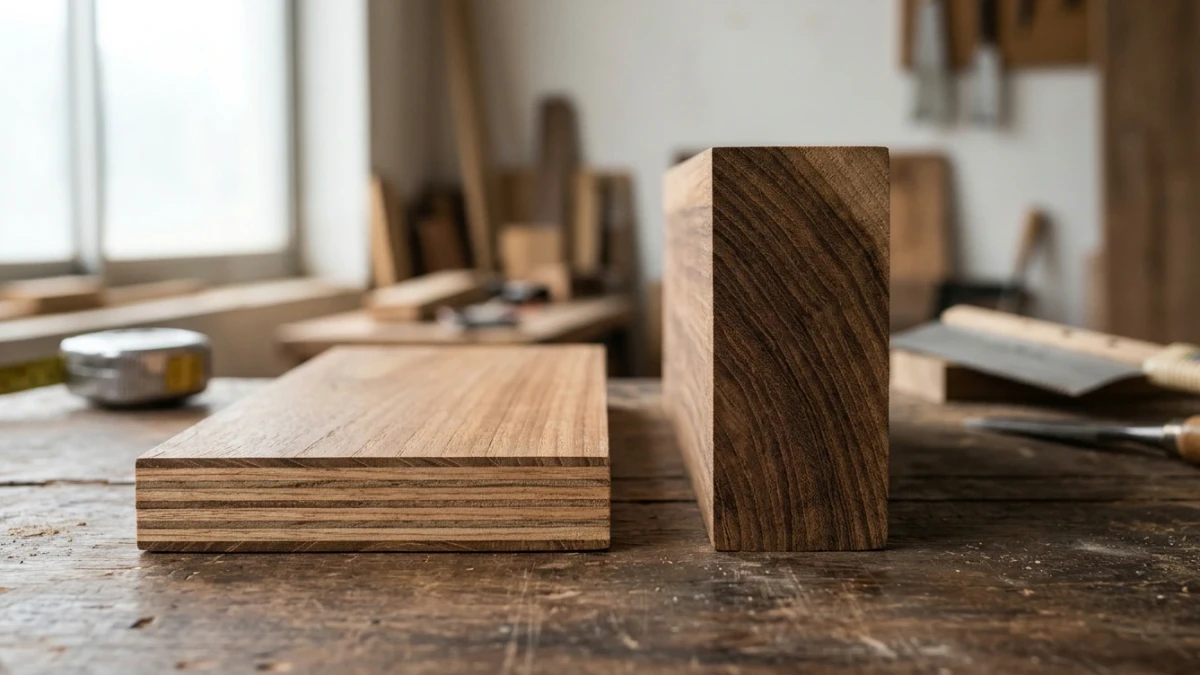
Solid wood furniture is cut from boards of a single timber all the way through, while veneer bonds a thin slice of real wood onto a stable manufactured core. Neither is automatically better. The right choice depends on the piece, how you plan to use it, and how it is built, and both can serve a Malaysian home well when the construction is sound.
This matters because the words get used loosely in showrooms. A table described as "wood" could be solid timber, a veneered panel, or a mix of the two in different parts of the same piece. Knowing how each is made helps you judge quality, plan for repairs, and spend your money where it counts.
What solid wood furniture and veneer construction actually mean
Solid wood furniture is built from boards milled from logs of one species, such as oak, walnut, or teak. The grain runs continuously through the thickness of each board, so a solid oak tabletop is oak from the surface down to the underside. Makers join narrower boards edge to edge to build up wide surfaces, which is normal and does not make a piece any less solid.
Veneer is a thin layer of real wood, often around half a millimetre thick on decorative furniture, sliced from a log and glued onto a stable base. That base is usually engineered wood such as plywood, MDF, or particleboard. The visible surface is genuine timber with real grain, but it sits on a manufactured core rather than solid stock underneath.
This is worth stressing: veneer is not fake wood. High-quality veneer is used widely in designer furniture because it lets makers apply beautiful, matched grain across large panels without the weight, cost, or movement of a thick solid slab. The quality lives in the thickness of the veneer, the stability of the core, and the strength of the bond.
Where each one is typically used
Legs, frames, rails, and chair components are often solid wood because they take stress and need strength through their full section. Wide flat surfaces such as cabinet sides, wardrobe doors, and some tabletops are good candidates for veneer, because a large solid panel is more prone to seasonal movement than a well-built veneered one. Many well-made pieces combine both, using solid wood where it works hardest and veneer where broad, stable panels are needed.
Durability, repairability, and cost
Durability depends more on construction and finish than on the solid-versus-veneer label alone. A solid wood joint done well will outlast a poorly bonded veneer, and a quality veneer on a sound core will outlast a solid piece made from badly dried timber. That said, there are real differences worth planning around.
The clearest difference is repair. Solid wood can be sanded back and refinished many times over its life, so scratches, water marks, and dents can be worked out and the whole surface renewed. Veneer faces are usually too thin to survive deep sanding, which means surface damage is patched, re-glued, or lived with rather than sanded away. If you want a piece you can restore for decades, solid wood gives you more room to work.
Veneer has its own strengths. Because the decorative layer sits on an engineered core, wide veneered panels are less likely to cup or crack as conditions change. Veneer also uses less of a prized species to cover a large area, which keeps the cost of walnut or figured-grain furniture more reachable than the same surface in solid stock.
On price, solid wood generally costs more for the same size of piece, both in material and in the labour of selecting and joining boards. Veneer lets a maker put a premium wood face on a larger item at a lower material cost. Neither route is a shortcut to quality on its own, since a cheap veneer on flimsy particleboard and a poorly dried solid panel can both disappoint.
How to tell them apart when shopping
The polished top of a piece rarely tells you what is underneath. Train your eye on the parts that reveal construction.
- Edges and corners. On solid wood, the grain on the top surface flows over the edge and continues down the side. On veneer, you often see a seam or a strip of edge banding where the thin face layer stops and the core begins.
- The underside and back. Flip a drawer or look at the back of a cabinet. Solid wood usually shows grain that matches front to back, while veneer may reveal a different material or a plainer surface on hidden faces.
- Grain continuity. On a solid board, the grain pattern on the surface relates to the pattern on the edge. If the top grain and the edge grain look unrelated, you are likely looking at veneer.
- Weight and sound. Solid timber tends to feel dense and sounds solid when tapped. A hollow or very light panel often signals an engineered core, though this alone is not proof.
- Ask directly. A reputable maker will tell you exactly which parts are solid and which are veneered, and why. A clear answer is a good sign.
If you want a deeper look at the signals of good construction, our guide on furniture craftsmanship walks through the joinery and finishing details that separate well-made furniture from the rest.
Which suits Malaysia's humid climate
Wood responds to the moisture in the air around it, and Malaysia keeps that air consistently damp. Relative humidity sits high for most of the year, which pushes wood toward a higher moisture content than furniture made for dry, air-conditioned countries assumes.
The relationship is measurable. Wood settles at an equilibrium moisture content that rises with humidity. According to Oregon State University Extension, wood reaches around 15 to 16 percent moisture content at 80 percent relative humidity, climbing to roughly 20 to 21 percent at 90 percent. Because wood shrinks and swells as that moisture content shifts, mostly across the grain rather than along it, furniture in a humid home needs to be built with that movement in mind.
This is where construction matters more than the solid-versus-veneer choice. Solid wood for Malaysian conditions should be properly kiln-dried and sealed on all faces so it absorbs and releases moisture slowly and evenly. A wide solid panel that is sealed on top but bare underneath can take on moisture unevenly and cup. Veneer on a stable engineered core has an advantage on broad surfaces here, since the core resists the seasonal movement that can trouble large solid panels.
Air-conditioning and the daily swing between a cool sealed room and the humid outdoors add their own stress. Whichever construction you choose, keep furniture out of direct sun, avoid parking it against a wall that gets afternoon heat, and wipe up spills quickly. These habits matter as much as the material itself, and they apply equally to solid wood and veneered pieces.
Why Nicchris leans toward solid wood craft
We design and make furniture in-house at our Sungai Buloh workshop, and for the pieces we are known for, solid wood is often the right call. A solid timber dining table or a set of chairs gets handled daily, knocked, and refinished over the years, and solid construction gives those pieces the strength and the second life that veneer cannot always match.
That preference is practical rather than dogmatic. We choose solid wood where it earns its place, in legs, frames, seats, and surfaces that need to be refinished down the line. Where a wide, stable panel serves the design better, a quality veneer on a sound core is a legitimate choice, and we are happy to explain which approach a given piece uses and why.
Working made-to-order lets us match the construction to how you actually live. We can specify the species, the dimensions, and the finish for your room and your climate, and build the piece to move with Malaysian humidity rather than fight it. If that approach suits you, read how our custom furniture process in Sungai Buloh works from first sketch to finished piece.
The useful takeaway is simple: judge a piece by how it is built, not by the label alone. Check the edges, ask what is solid and what is veneered, and think about whether you want to refinish it one day. When you are ready to see solid wood construction up close, explore the Nicchris collections online or arrange a visit to our Sungai Buloh showroom by appointment.