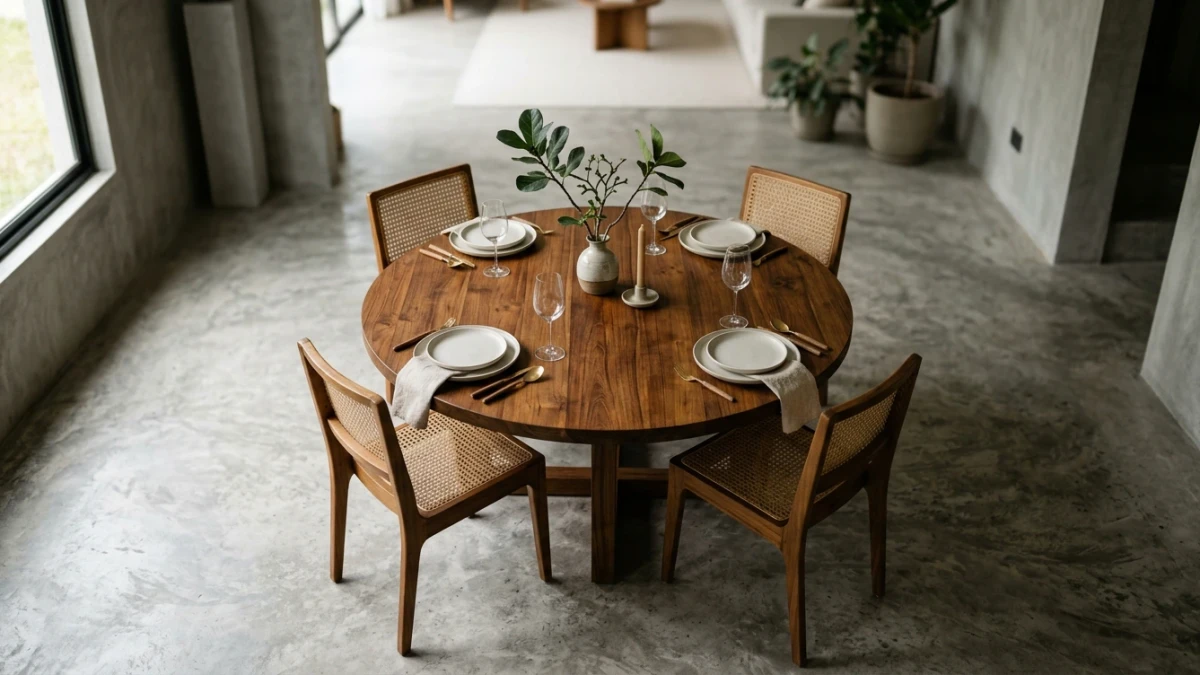
A round dining table works best when its diameter matches both the number of people you seat and the space you have to move around it. Get those two measurements right and everything else, from the wood to the base, becomes a matter of taste rather than a gamble. This guide walks through sizing, clearance, materials and base design so you can choose a table that fits your home instead of crowding it.
Why a Round Dining Table Suits Smaller Spaces
Round dining tables have become a practical favourite in Malaysian condos and apartments because a circle has no sharp corners to catch a hip or block a walkway. In an open-plan layout where the dining zone shares space with the living room and kitchen, that rounded footprint is easier to walk past. A circle also seats people more sociably, since everyone sits an equal distance apart and conversation carries across the table rather than down a long line.
There is a space-planning reason too. A round top of a given diameter takes up less floor area than a rectangular table seating the same number, which matters when your dining area is a corner of the living room rather than a separate room. For many homes in Sungai Buloh and the wider Klang Valley, that difference decides whether four people can eat comfortably or feel boxed in.
What Diameter Do You Actually Need?
Size the table by how much elbow room each person needs, then check the diameter against your floor. As a working guide, give each diner around 60 cm of table edge. That spacing keeps place settings from overlapping and leaves room for serving dishes in the middle.
Here is a simple reference for round tables:
- 90 cm (around 36 inches): comfortable for two, tight for four.
- 110 to 120 cm (around 44 to 48 inches): seats four, and four to six at a push.
- 135 cm (around 54 inches): seats six comfortably.
- 150 cm (around 60 inches): seats six to eight.
Most condo dining areas in the Klang Valley land on a 110 to 120 cm top as the sweet spot. It holds a family of four every day and stretches to six when guests come, without eating the whole room. If you regularly host larger groups, a 135 cm table is worth the extra floor space, but measure before you commit.
For the chairs that go around it, matching proportion matters as much as the table itself. Our guide on how to choose solid wood dining chairs covers seat height and width so the set feels balanced rather than mismatched.
How Much Clearance Should You Leave?
Leave roughly 90 cm between the table edge and the nearest wall, cabinet or sofa. That gap is the single most overlooked measurement in dining layouts, and it is why some tables look right on paper but feel cramped in person.
Think about what 90 cm has to absorb. A chair needs about 50 to 60 cm to slide back when someone stands, and a person walking behind a seated diner needs the rest. If a walkway runs along one side of the table, widen that side closer to a full metre so no one has to turn sideways to squeeze past.
The practical test is easy to run before you buy. Mark the table's diameter on the floor with masking tape, then add the clearance ring around it. Walk the loop. If you are brushing the wall or shuffling past a chair, step down a size. A slightly smaller table you can move around beats a larger one that pins you into a corner.
Which Wood Works Best for a Dining Table?
Teak, oak and walnut are all sound choices for a dining table, and the right one depends on the look you want and how the table will be used. Hardness gives a useful comparison. On the Janka scale, which measures a wood's resistance to denting, teak sits around 1,000 lbf, black walnut near 1,010 lbf, red oak around 1,260 lbf and white oak around 1,360 lbf (Missouri University of Science and Technology).
What does that mean at the dinner table? Oak's higher hardness makes it the most dent-resistant of the three, a point in its favour for a busy family table. Walnut is softer but prized for its deep brown tone and the way its grain flows across a wide top. Teak is the softest of the three on paper, yet its natural oils give it real staying power against moisture and humidity, which is why it has long been trusted in tropical climates like ours.
None of these is simply better than the others. A pale oak top reads light and Scandinavian, walnut feels warm and formal, and teak brings a mellow golden tone that ages gracefully. Whichever you choose, wood in a Malaysian home needs sensible care against our year-round humidity, so wipe spills promptly and keep the top out of direct sun and air-conditioning blasts that can dry and crack timber over time.
High-quality wood veneer deserves a mention too. On a large round top, a well-made veneer over a stable core can resist warping better than a single wide board, and it lets a maker book-match grain for a continuous pattern. The choice between solid timber and veneer comes down to the design and how the top is built, not a ranking of one over the other.
Why the Base Matters as Much as the Top
On a round table, the base shapes both comfort and capacity. A single central pedestal is usually the smarter pick because it clears the space under the table of legs, so chairs tuck in anywhere around the circle and no one straddles a table leg at dinner.
That open underside has a quiet benefit. Without legs staking out the corners, you can often slide one extra chair into a gap when an unexpected guest arrives. A four-legged round table looks sturdy and can be, but each leg claims a fixed spot and limits where people sit.
Balance is the thing to check with a pedestal. The base has to be weighted and wide enough that leaning on one edge does not tip the top. This is where construction quality shows, and where a made-to-order approach helps: the base can be sized to the top rather than borrowed from a standard frame. If you are weighing bespoke against off-the-shelf, our piece on what sets bespoke designer furniture apart explains how construction decisions like this one play out over the life of a table.
Matching the Table to Your Style
A round table is quietly flexible across styles, so let the top, base and finish carry the look. A light oak top on a slim pedestal reads clean and modern. A chunky turned base in walnut leans traditional. A thin metal pedestal under a timber top suits an industrial or contemporary room.
Think about the rest of the dining zone as a set. The chairs, any nearby sideboard and the table should share a material language, whether that is a consistent wood tone or a deliberate contrast you commit to. A round table also pairs naturally with a round or drum pendant light centred above it, which reinforces the shape and anchors the zone in an open-plan space.
Because round tops come in a limited range of standard sizes, made-to-order is often the way to hit an exact diameter for an awkward dining nook, or to match a specific wood and finish you have settled on. Building to your measurements means the table fits the clearance you planned rather than forcing you to plan around a size that was almost right.
Putting It Together
Start with the two numbers that decide everything: how many people you seat and how much floor you can give the table once clearance is added. Settle the diameter first, choose the wood for the look and use you have in mind, then pick a base that keeps legroom open. Mark it out on the floor and walk the loop before you buy.
If you would like help sizing a round table to a specific dining area, or want a particular wood, finish and diameter made to measure, explore the NICCHRIS furniture collections or arrange a visit to our Sungai Buloh showroom by appointment to see the timber and construction in person.